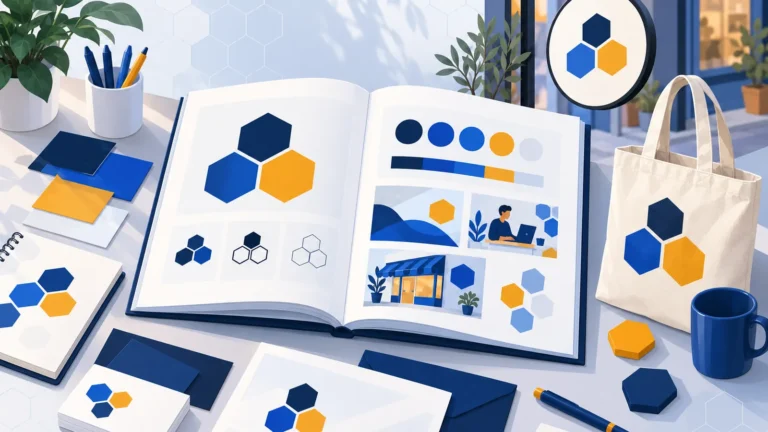
"I need a logo." It is how almost every brand project starts. And after a couple of questions it usually turns out that what is needed is something bigger… or something smaller. It depends on what you are after.
I am Miguel Ángel, founder of GUADIGITAL in Guadalajara, Spain. Let me explain it with an image that suits us here: honey. Think of a jar of honey from the Alcarria, the region around Guadalajara famous for it.
- The logo is the label.
- The brand identity is the whole packaging: the jar, the colours, the typeface, the box, the wax seal.
- The branding is why you buy that jar and not another: what you tell, how you tell it, what you promise and what you deliver.
Let us take them one by one.
What a logo is
A logo is the graphic mark that identifies your business. It can be:
- Text only (a wordmark).
- A symbol only (an icon or mark).
- Text and symbol together.
It has one job: to be recognised quickly. A good logo is simple, looks good small (a favicon, a social profile picture) and large (a sign), works in colour and in a single ink, and does not look like your competitor's.
A logo alone does not define how you speak, which colours you use or which style of photos represents you.
What brand identity (or visual identity) is
Brand identity is the set of visual elements that make up your image and are used consistently:
- The logo and its variants.
- The colour palette.
- The typefaces.
- The style of photography, icons and shapes.
- Templates and applications (business card, email signature, presentations, website, social media).
- Usage rules, normally in brand guidelines.
It is what makes all your pieces look like the same business. If your website is blue with one typeface, your card green with another and your sign something else, what you lack is not another logo: it is identity.
What branding is
Branding is the strategy and management of your brand. It includes the visual identity, but starts earlier and goes further:
- Who you are for and which problem you solve.
- What you promise and why people believe you.
- How you speak (tone of voice).
- Which values guide you and what you do about them.
- What the experience of dealing with you is like: the service, the reply, the delivery.
The brand lives in your customers' heads. You do not fully control it, but you influence it: with what you say, what you show and, above all, what you do.
The difference in one table
| Logo | Brand identity | Branding | |
|---|---|---|---|
| What it is | A symbol or text that identifies you | The complete visual system | The strategy and perception of your brand |
| Answers | How do they recognise me? | How do I look everywhere? | Why do they choose and remember me? |
| Includes | One or several versions of the logo | Logo, colour, typography, style, templates, guidelines | All of the above, plus positioning, messages and tone of voice |
| Shows in | Sign, profile, invoice | Website, stationery, social media | The whole customer experience |
| Scope | Small | Medium | Broad |
| Example deliverable | Logo files | Identity guidelines | Strategy + identity + voice guide |
Which one your business needs
This quick guide helps you decide:
| Your situation | What you probably need |
|---|---|
| You have just started and have nothing | Light branding: basic strategy, logo, colours, typefaces and tone |
| You have an acceptable logo but your pieces do not match | Brand identity: put colour, typography and applications in order |
| Good image, but your message does not connect | Branding: review positioning and tone of voice |
| Your logo is dated but your business works | Logo redesign within a coherent identity |
| You only need something temporary for an event | A simple logo may be enough |
One tip: do not start with the logo. Start by knowing what you sell, to whom and how you want to be remembered. The logo comes out much better afterwards.
Common mistakes
- Thinking a nice logo is a brand. It is one part.
- Changing colours and typefaces on every piece. You lose recognition.
- Copying the competition or using generic templates. If you all look the same, nobody remembers you.
- A logo that only works on a big screen. Test the small version.
- Not keeping the final files or not knowing who holds the rights. Ask for it in writing.
- Neglecting tone of voice. A beautiful site with cold or confusing copy breaks the brand promise.
Where to start with a new brand
- Write in one sentence what you do, for whom and why you are different.
- Pick 3 words that describe how you want to be perceived.
- Look at your competitors and note what you do not want to look like.
- With that in hand, work on logo, colour and typography.
- Define how you want to speak and write five example sentences.
If you want to see what a full project includes and what drives its price, I detail it in what is included in professional branding.
What I do
In my branding service I work from strategy to applications: logo, colour, typography and voice built with judgement, so your business is recognised in a second and remembered. Each project is quoted tailor-made, in writing and with clear deliverables. If you also need a website, see the pricing of my packs.
Get your free diagnosis
Tell me what you have today (a logo, a website, a mess of colours) and I will prepare a one-page report with what I would do with your brand, within 48 working hours and with no commitment. Or go straight to asking for a branding quote.

Miguel Ángel
I design websites and brands in Guadalajara, Spain. About me